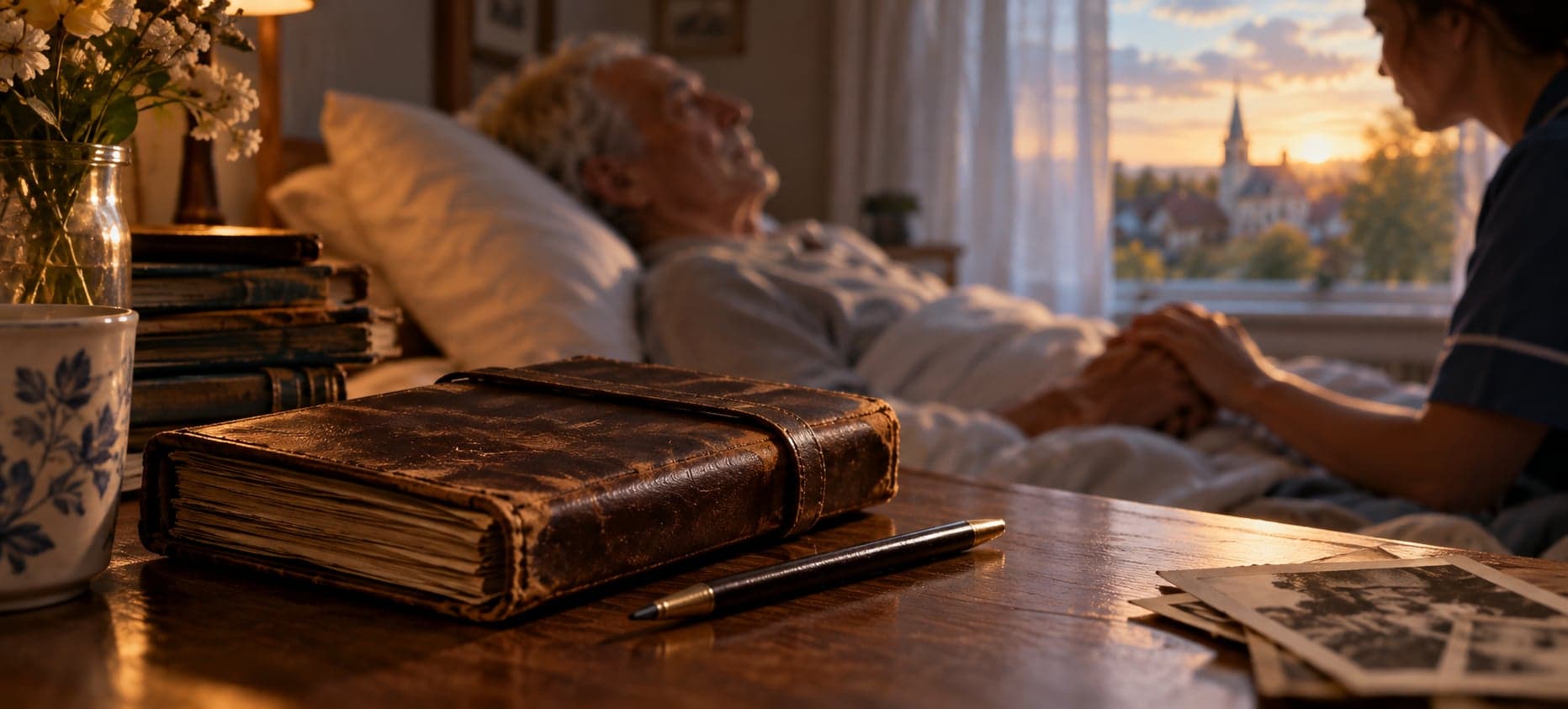
For forty years, Mr. Havisham has collected the final words of the dying, filling ninety-one notebooks with their regrets, memories, and quiet wishes. But when his own final moment arrives, he leaves behind a simple truth that changes everything: the words we save for the end are often the words we should have spoken while we were still alive.
بواسطة مُلهموقت القراءة 6 دقائق
13قراءة
اقرأ القصة
The Man Who Collected Last Words
Nobody in the town of Milbrook knew exactly what old Mr. Havisham did for a living.
He owned no shop, kept no farm, and had no office with his name on the door. Yet every few days, someone would see him walking toward the hospital, the nursing home, or a quiet house with its curtains drawn.
He always carried the same things: a small leather notebook and a pencil.
The children said he was a doctor.
The adults assumed he was a lawyer who handled wills.
Both were wrong.
Mr. Havisham collected last words.
________________________________________
It had begun forty years earlier, beside his father's bed.
His father had been a carpenter—a quiet man who rarely spoke unless he had something worth saying. During his final hour, he reached for his son's hand and said something the young Havisham had never expected to hear.
The words were simple.
But they were so tender, and carried such unexpected wisdom, that Havisham suddenly became afraid he would forget them.
He searched the room for something to write on. All he could find was the back of an old receipt.
القصة من تأليف الطفل كريم بعيون عمره ٧ سنوات .
في قرية ثلجية، يجد مازن سكاكر كثيرة تحت شجرة بيضاء، فيأكلها دون أن يعرف مصدرها. لكن فرحته تتحول إلى ألم، وتبدأ مغامرة يتعلّم منها الاهتمام بصحته وأسنانِه والاستماع إلى نصائح أمه. قصة من تأليف الطفل كريم، بخيال عمره 7 سنوات.
كريم
He wrote the words down before the moment disappeared.
He never stopped writing.
________________________________________
The story spread slowly.
People learned that Havisham never charged for his visits. When someone was dying, families began asking him to come.
He would enter quietly, sit in a corner, and make himself almost invisible.
He never asked the dying person questions.
He never tried to turn their final moments into something profound.
He simply listened.
And when someone spoke—to a daughter, a husband, the ceiling, or someone only they could see—his pencil moved softly across the page.
Forty years passed.
The notebooks multiplied.
One became a shelf.
The shelf became a cabinet.
Eventually, an entire room in his house was filled with them.
Ninety-one notebooks.
________________________________________
People imagined the notebooks must contain the greatest wisdom ever spoken.
Some of them did.
But Havisham had discovered something stranger.
When people came close to death, they rarely talked about the things they had spent their lives chasing.
Almost nobody talked about money.
Nobody wished for another promotion, another victory in an argument, or another year spent proving themselves right.
Instead, their final words were often embarrassingly small.
And strangely warm.
One woman whispered:
"Tell her the roses were never too much trouble."
A man who had spent most of his life working said:
"I should have gone swimming more."
Another asked:
"Is the porch light on? Leave it on for your brother."
One old man gripped Havisham's sleeve and insisted:
"I forgive him. Write that down. I forgive him."
A wealthy banker, surrounded by people who had spent years discussing money with him, said only:
"The lemon cake... your mother's lemon cake."
A decorated war veteran, his chest heavy with medals, whispered:
"Hold my hand. I held yours when you were small."
And the richest woman in the county smiled faintly and said:
"None of it was mine anyway. Isn't that funny?"
Havisham wrote every word down.
But over the years, he began to understand that the words themselves were not really the lesson.
The lesson was what people wished they had noticed before it was too late.
________________________________________
When Mr. Havisham turned eighty, the town council decided to honor him.
They invited him to speak at the town hall.
The room was packed.
Everyone wanted to know what forty years of listening to the dying had taught him.
What secret had he discovered?
What was the meaning of life, according to a man who had heard so many people speak from its very edge?
Havisham walked slowly to the podium with one of his notebooks in his hand.
He looked at the crowd for a long moment.
Then he smiled.
"I know what you want me to do."
A few people laughed.
"You want me to read you the wisest thing a dying person ever said."
He lifted the notebook.
"But I'm going to tell you something more important."
The room fell silent.
"There is something I heard again and again. Not always in the same words, but always with the same meaning."
He rested his hand on the cover.
"Almost none of them wished they had worked more."
He paused.
"None wished they had won one more argument. None wished they had held one more grudge. None wished they had spent another night worrying about things that never happened."
He looked toward the back of the room.
"What they wished was that they had noticed."
Someone shifted in their seat.
"Noticed the porch light."
"The smell of lemon cake."
"A small hand inside theirs."
"The person sitting beside them."
"The ordinary Tuesday morning they thought would come again tomorrow."
Havisham closed the notebook halfway.
"We spend so much of our lives waiting for life to begin."
His voice softened.
"Then, at the very end, we discover that it was happening all along."
No one spoke.
"So here is the only wisdom I can offer you."
He looked around the hall.
"Go home."
A few people smiled through their tears.
"Notice things."
"Say the soft word today, out loud, to the people who are still here."
He closed the notebook.
"Don't save your last words for last."
________________________________________
The following spring, Mr. Havisham died.
It was a bright Tuesday morning, and his bedroom window stood open to the garden.
During his final week, people came from all over Milbrook to see him.
But something had changed.
For once, Havisham did not sit in the corner taking notes.
He listened.
He smiled.
He held people's hands.
He let them talk.
It was almost as if the man who had spent forty years collecting other people's final words had decided, at last, to leave their words where they belonged—with them.
On his final evening, only a young nurse remained beside his bed.
She knew about the notebooks.
Everyone in Milbrook did.
When Havisham stirred and drew a slow breath, she leaned closer.
She thought he was about to speak.
Instinctively, she reached for a pencil.
She opened a fresh page.
For a moment, she waited.
Havisham opened his eyes.
He looked at her.
Then he looked at the pencil in her hand.
A faint smile appeared on his face.
"Put it down, dear," he whispered.
The nurse froze.
"I've said everything I needed to say..."
He took a slow breath.
"...while I was alive."
His eyes closed.
The nurse lowered the pencil.
She did not write down his words.
Not immediately.
A few minutes later, she opened the notebook again.
On the final page, beneath the last line Havisham had ever spoken, she wrote one sentence in a trembling hand:
"He lived what he had spent a lifetime collecting."
Then she closed the notebook.
And for the first time in forty years, Mr. Havisham had nothing left to write.
تبدأ ليلى عملها في فندق قديم بتحذير واحد: ابتعدي عن الغرفة رقم 13. لكن بكاءً خلف الباب يقودها إلى صور تشبهها وسجلات تربط اسمها بحريق وقع قبل عشرين عامًا. وكلما اقتربت من حقيقة الفندق، ازداد شكّها في هويتها وفي الأشخاص الذين يدّعون مساعدتها.
في مملكة أوريانا، تختفي أميرة في ليلة تتويجها، تاركةً خلفها رسالة غامضة. تبدأ رحلة البحث عن الحقيقة، فتكشف أسرار عائلية خطيرة، وتعود أميرة ظن الجميع أنها ماتت منذ خمسة عشر عامًا. لكن من يستحق العرش حقًا؟ وهل يمكن الوثوق بأقرب الناس؟
النهاية تخفي سرًّا لم يتوقعه أحد!
 عالم يستحق الاكتشاف